Punk History Vancouver
A few weeks ago at the Plaza Club Joe (”shithead”) Keithley and his band of rebels played an event that ended being a reunion of sorts. My friend and social media cohort, Dave Olson was there, as was Bev Davies, as I would have expected her to be, who snapped a few shots.
With the help of those who lived, breathed and experienced a musical era in this town that made a global impact I’ll be presenting a series of blog posts and podcast on this “Punk History Vancouver” page. I would not be able to do with without enlisting the help of Dave, who has already done his fair share of documenting, and big thanks to Rod for planting the idea in my head from which this page grew (and will continue to grow).
Blog entries, interviews and podcasts will be cross-posted below, either from my main site or Dave’s, and will include some of his podcasts and video podcasts.
Punk History Vancouver: Disco Sucks
Last modified on 2008-01-12 00:01:31 GMT. 2 comments. Top.
Remember when bands promoted a cause or took a stand not just because a record company told them they were going to be on a hit pre-fab compilation CD? When they would sing about injustices and weren’t sporting Louis Vuitton tracks suits in glossed over music videos? A huge part of the entire punk movement was staring the political and social issues of the day right in the face while building a community where bands and fans came together. One of the biggest movers and shakers in Vancouver has been (and still is) D.O.A.
With the new generation of punk you need the ones at the top to pick up the torch as musicians and artists can have an incredible effect on public opinion. If you only care about MTV and your cars and what you wear, going to award shows, I don’t care how loud and obnoxious the guitar is it isn’t really punk rock. Otherwise it just becomes another form of pop music. [The Punk Site - Interview with Joey Shithead from DOA]
Continuing the Punk History Vancouver series, I share more first-hand quotes from Dave Olson.
“While there were lots of different style of bands in Vancouver, the thing that connected the “scene” was a sense of social responsibility. My first DOA t-shirt taught me to “Think Globally, Act Locally” and “Talk minus action equals zero” - bands like Bill of Rights, House of Commons, SNFU (Edmonton), Young Canadians, Death Sentence and I, Braineater stand out as other acts reflecting this social conscience. No Means No and Dead Kennedys (from SF) were kind of the godfathers to the scene - NMN were already old back then and DK’s Jello Biafra collaborated with NMN and DOA which seemed to connect us to that California scene at bit which seemed to have more in common with Vancouver than we did with NYC or UK punk.”
The band (DOA) is known for its outspoken political opinions and has a history of playing for many causes and benefits. Its slogan is “TALK-ACTION=0″. The band has been active on many issues, including Anti-racism, anti-globalization, freedom of speech, and the environment. [wiki]
“One of my favorites shows ever was when DOA played at a 14 and older club in Surrey called Bumpers. The Spores and my friends’ band AOT (Abortions on Toast) opened. DOA were really nice (especially Dave Gregg) and I thought that it was very cool that you can let your aggression out in music and not on other people.
These guys made a big impression on me as songwriters and activists. Where ever I’d travel from Germany to Japan, they had a following and commanded much respect from other bands for their political attitude and relentless touring. I think it is important how they are always on board for activist causes with a song or concert whether marijuana legalization, slamming Social Credit policies, or supporting the Clayoquot blockades.
Incidentally, years later, I sang Takin’ Care of Business on stage with Joey and the boys while wearing my Canucks jersey, then the whole band came over to party and crash at my house.”
For more information about DOA including shows, their new DVD and even their podcast interview, head to the Sudden Death Records website or MySpace page.
…Read more Punk History Vancouver….
Punk History Vancouver: Bev Davies Calendar
Last modified on 2008-01-06 23:37:28 GMT. 2 comments. Top.
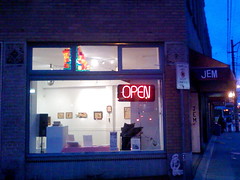
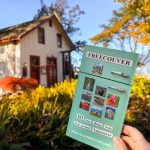
The other day Keira and I headed over to the Mount Pleasant neighbourhood of Vancouver for a mini-adventure. My main focus was the JEM Gallery, so I could pick up Bev Davies‘ Punk Rock Calendar.
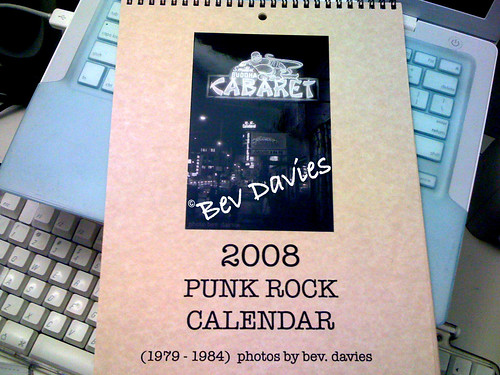
This is the second calendar that Bev has released, 2007’s “Nardwuwar the Human Serviette vs Bev Davies” being the first.
There are few photographers in this wonderful world who have taken pictures of both ’60s garage punk legends, The Barbarians and hardcore heroes, The Dead Kennedys. In fact, I challenge you to find one! And if you did, it would be Vancouver, BC Canada’s Bev Davies. [Nardwuar]
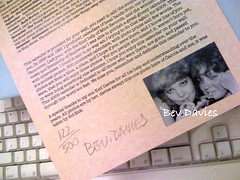
The calendar I bought is #122 of 500 made and each photo is removable so when the year’s over I can put them in a frame and display my very own Bev Davies snapshots. Artists featured in the calendar include: Buddy Selfish, D.O.A., No Exit, The Bill of Rights, Modernettes, The Dishrags, East Van Halen, Death Sentence, The Pointed Sticks, Los Popularos, Rude Norton, The Young Canadians, Subhumans.
“…The photos are from a time, a place, and I hope if you were there, and I know lots of you were, that you will enjoy these photos. For you people who missed it, weren’t born yet, or were doing something else, welcome.” - Bev Davies.
They’re available at the JEM Gallery, located at 225 East Broadway, which is in itself is pretty amazing (I spent some time coveting the fridge magnets that featured old neon signs of Vancouver).
I highly recommend that you pick up this piece of punk AND Vancouver history (for under $20).
…Read more Punk History Vancouver….
Smiling Buddha Cabaret
Last modified on 2008-01-11 06:47:58 GMT. 4 comments. Top.
From the NEW Punk History Vancouver page.
People often criticize the city for looking “too new” and not having “enough history”. That by being in its infancy on the world’s stage, Vancouver has none of its own culture, just a melting pot of others. It’s not that we don’t have history, it’s that we’ve glossed over several chapters that might not have been the most prim and proper.
When I was a teenager growing up in Surrey there was nothing more bad ass than coming downtown on the weekend and cruising Granville Street. I’m not talking about ‘cruising’ down the bubblegum-peppered sidewalks in our stilettos, purchasing some designer sunglasses, having crepes, then going club hopping shaking our lovely lady lumps.
The Granville Street that I remember was dark, dingy, grimey, and we felt like we were stickin’ it to the man when we’d sit on the sidewalk listening to a busker play rockin’ tunes at 1am, hours past curfew. But we were just posers. We weren’t the first wave of teenagers looking for economical entertainment. Just a few years earlier the dusky atmosphere of Granville that I revered was amplified with even more disreputable bars and even shadier characters.
Vancouver is home and was birthplace of some of the creators and perpetuators of punk rock, and the founders of the hardcore sound.
“Even when the “grunge” scene in Seattle went huge, Vancouver was more like “what’s new with that?”
Not only was the city on the cutting edge of punk rock, it was held in such high esteem as London, New York and San Francisco when it comes to the cities that created and sustained this genre’s existence. Men with names names that contained “shithead” and “rampage” were held in the highest esteem, among several others:
“The Subhumans and the handful of other punk bands that exploded into being in Vancouver as part of the world-wide punk movement, built a local scene that was wild, raucous, and tempestuous. Venues came and went after gigs that left audiences exhilarated and club-owners and police appalled. The now-familiar punk ethos that held that anyone could be in a band, and that any band could change your life, was new and shocking.” [Subhumans.com]
Describing my peers and myself back then, I immediately think of a great article I read in The Nerve Magazine. It was an interview with Bev Davies, the photographer that captured the entire Vancouver punk scene like no one ever has or will.
“…I spent a little while taking shots of rocks and birds and then I went to my first DOA concert and went HOT DAMN! No more ’still life with fruit-bowl’ for me!”. [The Nerve Magazine]
Bev was a regular at the Smiling Buddha Cabaret, which was was located at 109 East Hastings. In the Nerve article she talks about taking photos of DOA playing Friday night, go home and develop the film, then come back Saturday night with a box of photo postcards for sale. The Buddha was a dive and at the same time a mecca for local and international alternative rock acts. From The K-Tels, The Subhumans, DOA, or Mother Tucker’s Yellow Duck, to Jimi Hendrix and Jefferson Airplane.
Vancouver’s music community thrived in the 70s and 80s, experiencing a city full of dank corners, sticky floors and the darkest of alleys.
Artists were struggling, playing in dives, scraping together the dough to make albums themselves, and that’s what gave the city’s scene its character. This Vancouver was known for more than the Grouse Grind, organic produce and Robson Street shopping.
The downtown east side was home to seedy clubs in which groundbreaking bands would play for college students before they hit it big. Granville street hosted cheap beer and pizza slices, and Yaletown was for sketchy after-hours parties in warehouses nobody would recognize or remember in the morning.
For almost a hundred years Yaletown was the terminus for goods from back East, as they were stored in the areas many warehouses then shipped out at the port. Industrialized and abundant with manufacturing plants and mills, plastered in coal, dark wood and brick, these buildings budded up at the beginning of the century and polluted for decades to follow.
A world-class fair arrived in 1986, bringing with it months of construction, expansion, development and tourists. Expo 86 was built on a 207-acre wasteland of property at the south end of downtown, bordering and wrapping around False Creek, although concentrated in Yaletown. It painted the city with a new brush, one that would drive up prices, pump in tourism and push out squatters of all kinds.
“Then everything went teal.”
“With Expo, Vancouver’s character changed with modern buildings and the outside world paying attention to this fresh, fabricated, fashionable facade which evoked cynicism from many locals. Suddenly, Vancouver went from a grimy hardcore town to a hot bed for hair-metal bands coming up for the peeler bars and top producers.”
Afterwards, the Expo lands were vacant and displaced until foreign investors hopped into the ring and turned Yaletown into what you see today. No anarchists in sight.
Warehouses were flipped into swanky office buildings while heritage houses, corner shops and live music meccas were demolished to make room for million-dollar homes, stacked and towering above the cracked cobblestone streets.
Punk-enlightened venues started disappearing and being replaced with glazed condo developments, one by one. No more Luvafair, Town Pump, Starfish Room, and the ‘Buddha on Hastings finally closed down in 1993.
“Venues like the “New” York Theatre closed down, changed formats and ownership and punk went back underground surfacing into the mainstream consciousness as protest music.”
Today, it seems like dark corners of Gastown are transforming into upscale furniture stores, and greasy spoon mom ‘n pop cafes are morphing into bistros with pretentiously cut yam fries. Old brick buildings are being gutted and filled with million-dollar loft spaces. Looking back at the last few decades, it seems as though this city’s record is skipping.
Vancouver has a culture, it actually has a sound and people who thrive off its community. We just need to remember just how far back this goes and that even the City of Glass has rebel roots that live on.
Read more in this series on the NEW Punk History Vancouver page. Quotes in this post were provided by Dave Olson.